About

This blog contains the details about the place called DANGS located in the state of Gujarat, India. It narrates the places of interest and culture of this tribal hinterland of south Gujarat.
Showing posts with label Travel. Show all posts

Wednesday, 14 December 2011

Gira Waterfalls in Dangs, Gujarat

Located at a distance of 5 km from Waghai off Waghai-Saputara road, the Gira waterfall is a 30 m natural plunge into the Ambika river. Breathtakingly beautiful, this seasonal waterfall (June-December) is among the most picturesque sights in the district.


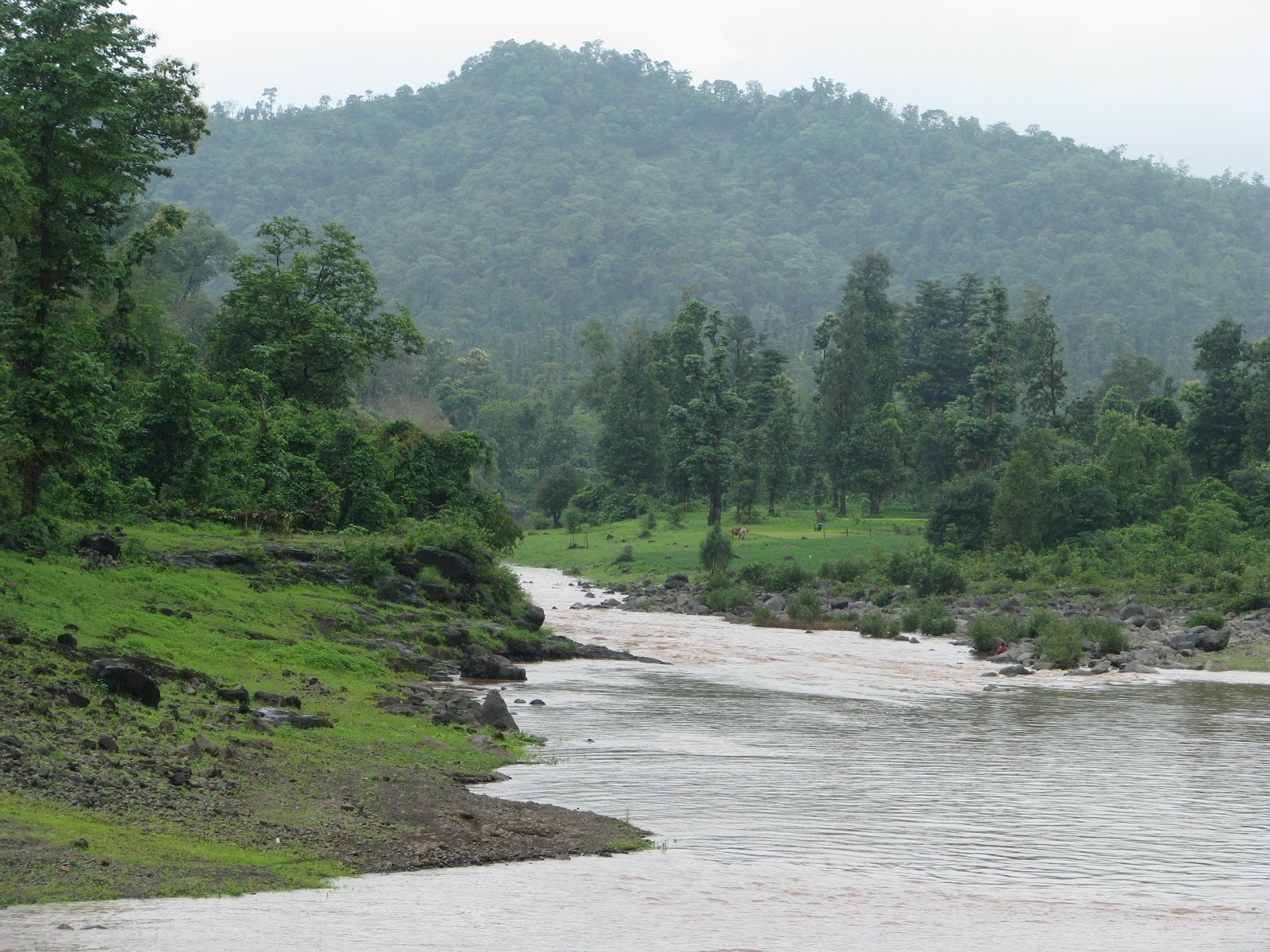
Rising in the Kem hills situated near Bondarmal (Dangs) and Shribhuvan (Maharashtra) villages, the river Ambika flows past Rambhas and Waghai villages of the District and finally meets the Arabian Sea near Bilimora in Valsad district.

 There are some tea and snacks stalls along with view huts for relaxing and picnicking. Some make-shift shacks selling various local handicrafts from bamboo. A typical Dangi village named Ambapada is located near Gira falls. The route is soothingly scenic as it is surrounded by lush and tall bamboos. The tourist can take a walk in and around the village and visit some tribal 
artists making various handicrafts from bamboo stem and roots.


Botanical Garden at Waghai, Dangs, Gujarat


The Botanical Garden is situated 2 km away from Waghai village on Waghai-Saputara road. Established in 1966, the 24 hectares garden is the largest garden in Gujarat. Besides ex-situ conservation of rare, endangered and endemic species; the Garden 
Botanical Garden, Waghai
nurtures a diverse array of 1400 plant species and 1077 genera representing 100 families. The Garden has systemic network of internal roads spreading over 7 km in length. Each avenue is named after species that are planted there on both sides e.g. Neem road, Ashok road, Anacardium road etc. There is a collection of about 8000 Herbarium sheets of 1000 species. The Garden is divided into several plots representing different forest types such as evergreen, moist deciduous, dry deciduous, scrub and thorn, arid zone etc. as classified by Hutchison and Seth. Besides these, the garden has other separate plots like taxonomy plot, medicinal plot, bamboo plot, palm plot, Dangs plot, orchid plot and rose plot. Apart from excellent collection of cactus, the garden contains variety of bamboo species such as Chinese bamboo, Golden bamboo, Beer bottle bamboo etc.
Locomotive Steam Engine, Botanical Garden, Waghai

Attracting more than one lakh tourists each year, the Garden is equipped with interpretation center, library, research and demonstration center, meeting hall, drinking water and sanitation, canteen and a rest house. The garden is open from 8am-6pm and entry is free.

People of Dangs, Gujarat


Self-contented to the extent of being misunderstood as lazy, the people of Dangs have a sturdy spirit of independence and intolerance of any external interference in their traditional habitat. By virtue of these qualities, they fought to the last ditch against any external influence whether it was from the Peshwa, the Gaikwad, the British or any other neighboring States. They are content to stay in their forest fastnesses.

For them, life is a long celebration. They live as there is no tomorrow. The virtue of “shyness of contact” with outsiders has left them on their own. Veneration for nature is a way of their life. They don’t need lessons for nature conservation. It is inherited since generations.

With 98% of the total population comprised of tribals, the district is inhabited by two main tribes, namely, Bhils and Kunbis, with a sprinkling of a few Warlis, Mavchis, Gamits, Kotwaliyas and Kathodiyas. There are three ethnic tribes identified as Primitive Tribal Group (PTG) also resides in the district: the Kotwalia, Kathodi and Kolcha.


The ecological factors of Dangs have provided them with a common ethos out of which a common Dangi personality has evolved. This personality is characterized by a typical mode of thinking, feeling and behaving. Common beliefs and attitudes, sentiments and ideals are at the basis of a Dangi personality. A Dangi lives a hard and monotonous life. By nature he is introvert and individualistic. Living as he does in the forests and mountains, he has imbibed from the soil a sturdy character and love of freedom.


Houses are generally crude (kutcha) huts of teak poles and bamboos, with the roof either thatched or covered with country tiles (nalia), walls made of bamboo splits or thick bamboo matting plastered with mud on both sides. The houses are provided with mud floors with cowdung plaster. Roofs are generally low and very few houses have windows. 

Dangs - A Beautiful Tribal District in Gujarat, India


Remarkable, bewildering, irresistible – Dangs offers one an ideal spot to escape from the crowds. Whether it means a hilly village, a luxuriant landscape of bamboos or a place related to Dandakaranya of the Rammayan; the Dangs is simply irresistible.

Gira Falls at Waghai, Dangs, Gujarat
Dangs has so far remained one of Gujarat’s best-kept secrets. Nestled in the rugged mountain chains of Sahyadri, the Dangs is a hilly tribal terrain with lush green forests, fascinating landscapes and abundant oxygen. With one National Park and one Sanctuary, the district epitomizes ideal coexistence of human life and wildlife.

Indian Chameleon
Though the district comprises 0.89% (1764 sq. km.) of the total area of the State of Gujarat, it covers around 30% of the forest area of the State. This signifies the importance of the Forests in Dangs. This apart, the District is one of the richest biodiversity spots in the Werstern Ghats. Purna sanctuary is an ideal place for nature lovers and bird watchers. Monsoon is an occasion for celebration and a reason to rejoice and reverberate oneself.

Spiders in Forests of Dangs
Situated between the parallels of latitude 200 33’ and 210 5’ N and the meridians of longitude 730 27’ and 730 56’ E, the district comprises an area of 1764 sq. km. spread over 311 villages. The length from north to south of this territory is around 59 km and east to west is around 50 km.


The district is bounded on East and South by Dhulia and Nasik districts of Maharashtra and on North and West by Tapi and Valsad districts of Gujarat. Very sparsely populated, the district with headquarters at Ahwa, is a home to more than 2 lakh people majority of whom are tribals.


Getting There

By Road:


Waghai, Bheskatri and Bardipada are the entrance points from Gujarat and Shingana, Chinchli (Babulghat), Galkund (Kanchanghat), Saputara and Lahanmalunga are the entrance points to the District from Maharashtra.

On the West, NH-8 lies close to the Dangs. Traveling by a private vehicle on NH-8, one can take a turn towards east either from Chikhli cross-roads or Kharel cross-roads or Kadodara cross-roads and arrive at Vansda. Driving further east, one arrives at Waghai (18 km), the entrance point to the District. Alternatively, take a turn towards east from the NH-8 at the Kadodara cross-roads and arrive at Vyara (50 km). Hereon, one has two options: move towards south-east and arrive at Bheskatri (22 km) or move further east, arrive at Songadh (10 km) and from Songadh move towards south-east and arrive at Bardipada. Traveling from Mumbai on NH-8, one can take a right turn from Vapi cross-roads and arrive at Dharampur (45 km), drive towards north-east and arrive at Vansda (35 km).

This apart, there are daily road services from Gujarat State Road Transport Corporation (GSRTC) to Ahwa, Waghai and Saputara from Ahmedabad, Vadodara, Surat, Bilimora, Chikhli and Valsad.

By Rail:

Waghai, the only rail terminus in the District, lies on the Bilimora-Waghai narrow gauge section of the Western Railway. The total length of the line is 63 km with two railway stations – Dungarda and Waghai in the District.

The nearest rail stations on the broad gauge sections of the Western Railway are Bilimora, Chikhli, Valsad and Vyara – all at a distance of around 100km.

By Air:

The nearest airport is in Surat, 120 km away. Others are at Mumbai (250 km), Vadodara (309 km) and Ahmedabad (420 km).


Getting Around

The Dangs can best be explored in a private vehicle as bus services to various tourist spots across the district are not so frequent. Hence private shared jeep services to and fro from Ahwa and Waghai are more prevalent here.

When to go

The climate hilly district of Dangs, is characterized by general dryness except during the monsoon months. Much extremes of temperatures are not experienced. Winters run from December to February, summers from March to May, south-west monsoon from June to September and post-monsoon in October and November. With an average rainfall of around 100 inches, the best time to visit the District is from August to February.


Roads

Dangs is now well connected by a network of tar roads with Gujarat and Maharashtra. All weather tar roads connects the District to Ahmedabad, Baroda, Surat, Bilimora, Valsad, Vapi, Navsari, Songadh and Vyara on the Gujarat side and Nasik, Surgana, Malegam, Nandurbar on the Maharashtra side. This apart, the District has a good internal network of tar roads. 

Health Facilities

Government health services in the District include a Civil Hospital at Ahwa, a Community Health Center at Waghai and seven Primary Health Centers (PHCs) at Kalibel, Pimpri, Sakarpatal, Shamgahan, Saputara, Garkhadi and Subir.  This apart private medical hospitals and clinics are located at Ahwa and Waghai.

Local Dialect

The dialect spoken here is known as Dangi. It has no script. It has borrowed largely from Gujarati, Marathi and Khandeshi. The affinity in the dialects of different tribes living in the district is very close.


I worked as Mamlatdar and Sub Divisional Magistrate in Dangs for almost 4 years. During these years, I traveled extensively through the District (visiting all 310 villages at least 4 times) visiting all the places of interest and clicked more than 3000 photographs. In the posts to come I will give the details of history, people, culture and places across Dangs.